
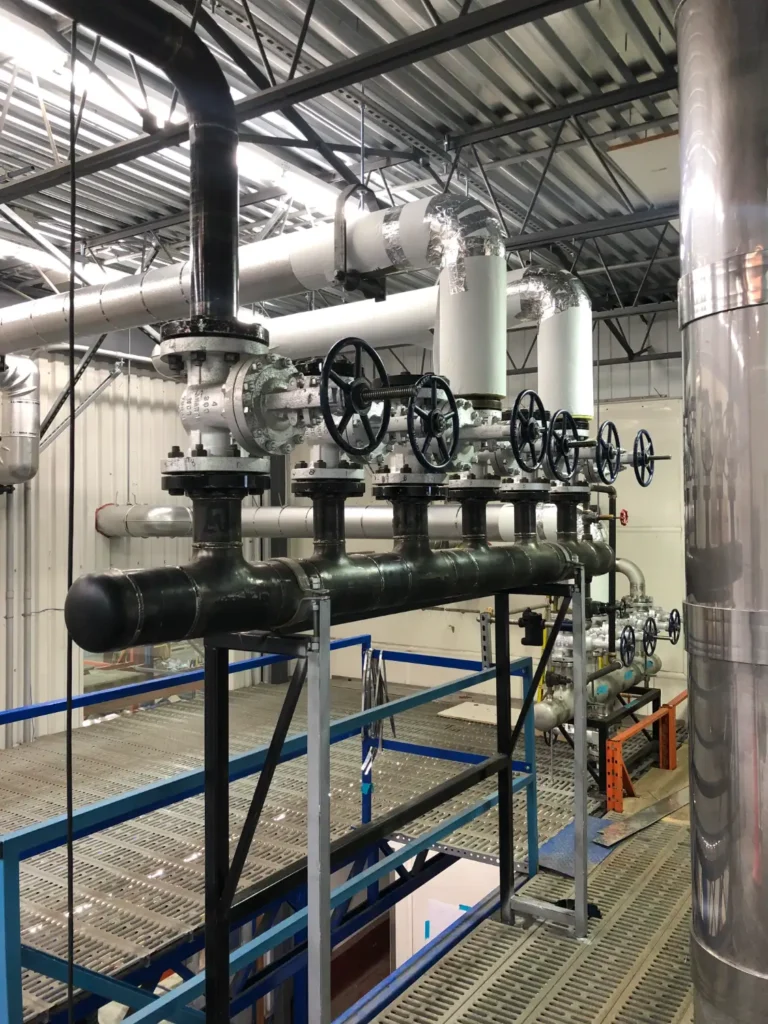
Starting in January 2027, we are launching our “Steam system maintenance and optimization” service. It connects your maintenance work with your plant’s thermal needs.
Soteck Clauger is adding a service dedicated to steam and condensate systems. It is designed for industrial, agri-food, pharmaceutical, manufacturing and institutional sites in Québec and eastern Canada. It builds on our expertise in industrial piping.
Why address your steam system now?
Steam remains essential to many plants: for processes, heating, washdown and production. Steam systems have often grown alongside plant expansions. According to the U.S. Department of Energy (DOE), 15% to 30% of steam traps may be faulty in a system left without maintenance for three to five years (1).
The regulatory framework is also changing. The amended Regulation respecting pressure installations has been in effect since July 29, 2026 (2). Among other changes, it reinstates periodic inspections by the RBQ (2).
Steam connected to the rest of the plant
We help you identify steam system issues and prioritize corrective work. We then track the results with you.Our goal is to connect your maintenance work with your reliability and energy efficiency priorities.
Our steam specialist already provides steam trap inspections and installation advice. We start with the plant’s thermal needs and process reliability. We then study heat recovery from steam and condensate systems (6). Some hot water needs could be met by an industrial heat pump rather than steam, to optimize energy savings and reduce GHG emissions.
This approach builds on our published industrial piping and heat pump projects.
“A well-drained steam system heats up faster and breaks down less often.”
Jean-Luc Boisvert, Account Manager and Steam Designer at Soteck Clauger
Caption: the path of steam from the boiler room to the condensate return. Point 7 shows the heat that refrigeration can transfer to hot water. Soteck Clauger schematic.
Four signs your steam system needs a diagnosis
A heat exchanger is not heating sufficiently.
Condensate accumulates, even with a new steam trap (3).
Water hammer can be heard at startup.
It is often caused by poorly drained condensate (4). It can damage a gasket or valve.
Steam is escaping from vents.
This may be normal flash steam or a live steam leak (5). Only an inspection can determine which.
Steam traps are leaking.
With a regular inspection and maintenance program, leaking steam traps should account for less than 5% of the total (1). Keep an up-to-date register of equipment and “CDL” steam traps.
Details of the checks are available on our Steam system maintenance and optimization page.
What our service includes
- Targeted diagnosis: steam trap inventory and testing, and an issue register.
- Corrective action plan: priorities based on safety, production and energy.
- Work: installation, equipment replacement and insulation.
Each mandate specifies the equipment included and any exclusions. Boiler room monitoring and chemical treatment of boiler water remain the responsibility of your specialized maintenance team.
Prepare your steam system before a planned shutdown
A planned shutdown is the best time to make corrections to a steam system.
A few steps taken several weeks beforehand make the work more effective.
- List your steam equipment and its known symptoms.
- Record operating pressures and note how they vary with load.
- Identify where each condensate return goes: tank, pump or drain.
- Check your eligibility for the Énergir program and register before work begins (7).
- Schedule the shutdown window with your maintenance mechanics.
- Order long-lead parts identified during the diagnosis early.
Who is our service for?
Our service is for all plants that use steam for heating, cooking or washdown. Here is what each team can expect.
| Team | What we deliver |
|---|---|
|
Maintenance |
Steam trap register, causes of recurring failures, clear priorities |
|
Production |
Heating deviations explained, production losses limited, work scheduled during production shutdowns |
|
Energy and environment |
Consumption baseline and reduced losses |
|
Management and finance |
Decision-making file: costs, risks and eligible financial incentives |
How do you start your steam project?
Tell us about your system and your main concern.
We will propose an initial scope for the diagnosis.
To understand the role of steam in your energy balance, the Flash Audit is a good starting point.
Funding program available
Is your steam produced mainly using natural gas? The Énergir incentives page advertises “up to $106,700 per maintenance project.”
This figure combines the audit ($6,700) and the $100,000 cap (7). Our financial engineering team will check your eligibility with you.
| Measure | Incentive | Maximum eligible amount |
|---|---|---|
|
Steam trap audit |
Up to $6,700 per audit |
100% of eligible costs |
|
Replacement or repair of faulty steam traps |
$100 to $225 per steam trap |
50% of eligible costs |
|
Automatic monitoring system |
Rental: $100 per steam trap Purchase: $550 per steam trap |
50% of eligible costs, up to $100,000 per year for rental and $100,000 for purchase |
|
Thermal insulation |
$150 per steam trap |
50% of eligible costs, up to $100,000 per year |
Amounts published by Énergir for steam trap maintenance, accessed November 16, 2026 (7). The distributor states that its incentives may change without notice.
Steam systems: questions we are asked before a diagnosis
A heat exchanger that is not heating properly, water hammer at startup, an approaching annual shutdown: here is what maintenance and energy managers ask us before starting a steam system diagnosis.
Answers validated by Pierre-André Poirier Guay, Eng., on November 16, 2026. Technical questions are addressed on our Steam system maintenance and optimization page.
When will your new steam service be available?
Starting in January 2027. If your annual shutdown is in spring or summer 2027, now is the time to discuss it. The diagnosis is performed first, while the system is operating, and corrective work is carried out during the shutdown. In between, we order long-lead parts and you have time to register for the Énergir program before work begins.
What does industrial steam system maintenance include?
Everything between the boiler room and the condensate return. This includes headers, drain lines, pressure-reducing stations, steam traps, insulation and steam-using equipment. The boiler and its water treatment remain your team’s responsibility.
You receive a steam trap register and a prioritized corrective action plan. Each steam trap is classified as compliant, leaking, blocked or untested. The work concludes with startup tests. The register then becomes your starting point for the next inspection.
How does this service differ from a steam trap inspection?
An inspection identifies which steam traps are leaking or blocked. Our service also investigates why they failed; otherwise, a new steam trap may fail in the same place. Common causes include a steam trap that is unsuitable for the load, excessive return backpressure and inadequate drainage. We correct the cause, then check the result under load.
Does production have to stop for a steam system diagnosis?
No, not for testing. A steam trap is tested in operation, under pressure and under load. We recommend starting with observation, then taking measurements (9). Corrective work requiring a line to be isolated and drained is scheduled during a shutdown. You receive a list in advance, along with the parts to order.
Is a financial incentive available for steam traps in Québec?
Yes, through Énergir, if more than 50% of your steam is produced using natural gas (7). You must register before work begins, and our financial engineering team will check your eligibility with you. The steam trap audit may be covered at 100%, up to $6,700 (7). Each repaired or replaced steam trap qualifies for an incentive of $100 to $225, up to 50% of costs (7).
Does the service replace the regulatory inspection of boilers?
Does the service cover culinary steam?
Yes, in collaboration with your quality team. For steam in direct contact with food, the CFIA recommends potable feedwater (8). Additives must be suitable for the intended use (8).
The CFIA also recommends sampling condensate between the final separator and the injection point (8). The boiler must be operated without foaming or water carryover (8). We install the separator, filter and sampling point required by your preventive control plan, then document the installation for your audits.
How are savings measured after the work?
By comparing before-and-after performance over comparable production periods. We first establish a baseline, for example in kilograms of steam per tonne produced. Corrected losses are estimated using a documented method, such as the DOE method (1). Verified savings are presented separately from estimated savings. This allows management to see what has been measured and what remains a projection.
Article written in collaboration with our experts:

Jean-Luc Boisvert
Account Manager and Steam Designer
Jean-Luc joined Soteck Clauger in October 2026 as an Account Manager and Steam Designer. He has more than 33 years of experience in industrial processes and maintenance, and has completed over 200 inspections and diagnoses of steam applications.
Areas of expertise: steam and condensate systems, steam traps, diagnosis and inspection, industrial maintenance.

Pierre-André Poirier Guay, Eng., has been with Soteck Clauger since 2006. He has more than 20 years of experience in building systems and industrial processes. He turns complex needs into sustainable, high-performance solutions.
Areas of expertise: engineering, piping, NH₃ and CO₂ refrigeration, energy efficiency.
Article written November 20, 2026, with regulatory information and funding programs verified on November 16, 2026.
Conclusion and sources
Soteck Clauger’s new steam service will be available starting in January 2027. It covers steam system maintenance, from steam traps to condensate return, at industrial and institutional sites in Québec and eastern Canada. In agri-food plants, steam system maintenance is also carried out with the quality team, in accordance with CFIA requirements for culinary steam.
Two factors make this decision timely. The amended Regulation respecting pressure installations has been in effect since July 29, 2026. Énergir’s steam trap program covers the audit and part of the replacement costs, subject to its continuation in 2027. Connecting steam and industrial refrigeration also creates practical heat recovery opportunities, as shown at point 7 of our schematic.
To prepare your steam system before a planned shutdown, email Jean-Luc now: together, we will define an initial scope for the diagnosis.
Sources consulted on November 16, 2026: public bodies (RBQ, CFIA, Government of Québec, U.S. Department of Energy), energy distributor (Énergir) and manufacturer’s technical documentation (TLV). The Énergir amounts are those published on that date. The distributor states that its incentives may change without notice, and their continuation in 2027 remains to be confirmed.
- U.S. Department of Energy, Advanced Manufacturing Office, Inspect and Repair Steam Traps, Energy Tips: Steam, Steam Tip Sheet #1, DOE/GO-102012-3401, January 2012. Cited for: the proportion of faulty steam traps in a system not maintained for three to five years, and the method for estimating losses. View the fact sheet
- Régie du bâtiment du Québec, Pressure installations: regulation published for entry into force, news release dated July 15, 2026, effective July 29, 2026. Regulation to amend the Regulation respecting pressure installations (CQLR, c. B-1.1, r. 6.1). Cited for: the resumption of periodic inspections by the RBQ. Read the news release
- TLV, What is Stall?, Steam Theory, Steam Trap Problems section, page accessed in 2026. Cited for: condensate accumulation in a heat exchanger despite a new steam trap. Read the article
- TLV, Water Hammer: The Mechanism, Steam Theory, Steam Trap Problems section, page accessed in 2026. Read the article
- TLV, Flash Steam, Steam Theory, Basics of Steam section, page accessed in 2026. Read the article
- U.S. Department of Energy, Advanced Manufacturing Office, Return Condensate to the Boiler, Energy Tips: Steam, Steam Tip Sheet #8, DOE/GO-102012-3410, January 2012. Cited for: the energy savings from returning condensate to the boiler. View the fact sheet
- Énergir, Steam trap maintenance, energy efficiency programs for business customers, page accessed in 2026. Cited for: eligibility conditions and financial incentive amounts for steam trap audits, repairs and replacements (up to $106,700 per maintenance project). View the program
- Canadian Food Inspection Agency, Culinary steam, preventive controls, guideline related to the Safe Food for Canadians Regulations, amended April 16, 2019. View the guideline
- TLV, A Guide to Steam Trap Testing, Steam Theory, Steam Trap Considerations section, page accessed in 2026. Read the guide
- Government of Québec, Stationary engine mechanic certificate, class 3 (MMF-C3), Stationary Enginemen Act and Regulation, CQLR, c. M-6 and M-6, r. 1. View the fact sheet