
Fabric duct systems for hygienic air distribution
Perforated textile ducting designed, installed and maintained for food plants across Eastern Canada.

Poorly diffused air costs your productionmoney.
In food plants, air carries contamination and almost nobody budgets for it. A badly designed network leaves stagnation zones where microbial growth takes hold. Cleaning-in-place protocols then get longer and more expensive to compensate. The same pattern shows up in ripening rooms, dairies, cutting rooms and processing halls.
Rigid metal ducts collect contaminants and complicate every maintenance call. They also generate product losses nobody has put a number on. A fabric duct changes how the air arrives in the room. Ours replaces heavy sheet metal with a lightweight, washable textile.
Air leaves through thousands of calibrated openings along the full length. No drafts hit the product and no hot spot builds at the far end. Each system is sized on your real production data, not on a catalogue table. Air volumes, room temperatures, humidity targets and cleaning cycles all drive the design.
What comes back is a cleaner room and maintenance your own team can handle. Your refrigeration equipment also stops fighting an uneven load. That shows up on the energy bill from the first season. Our written performance guarantee puts a number on it before you order.
Fabric duct, textile duct, duct sock, same equipment
North American plants and specifications usually say fabric duct or fabric ductwork. European engineering offices and our manufacturer ATC write textile duct or textile ducting. Contractors on site often say duct sock, air sock or cloth ductwork. Every one of those names describes the same permeable duct.
The equipment releases air along its length instead of pushing it through a few grilles. So a specification and a quote can use different words for identical hardware. What actually differs between suppliers is the sizing behind the words. Two quotes using the same words can hide very different sizing. Ask for the diffusion mode, the fabric family and the air velocity at the product.
Our fabric ducts fit your HACCP protocols
Lightweight, taken down in minutes, washed in a machine.
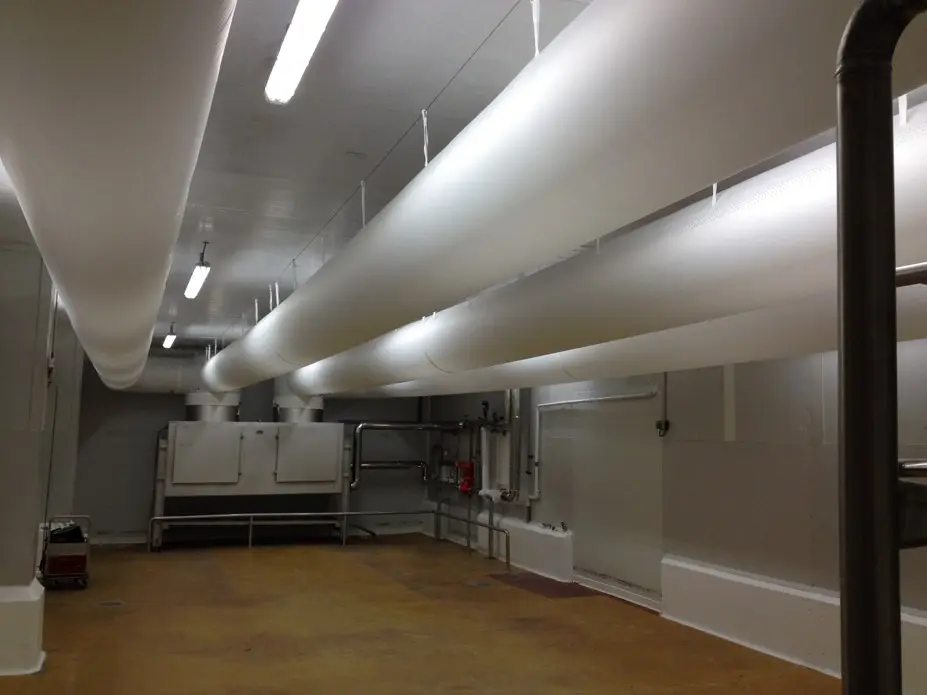
A fabric duct comes down without scaffolding and goes into a washing machine, which is why it fits the HACCP protocols that rigid ductwork fights. Air leaves along the whole length of the run, so aggressive drafts, hot spots and dead zones disappear from the room.
We integrate ATC (Aero Textile Concept) products, a French manufacturer with a long record in industrial markets. Our installations are certified CAN/ULC S102.2.
Room geometry and production constraints drive the design on every project.
How fabric air distribution works
Controlled fabric permeability, in three diffusion modes.
Rigid ductwork pushes air out of a few points. A fabric duct releases it across its entire surface. Which mode we specify depends on your process.
- Calibrated holes, Ø 1 mm to 18 mm. Directional diffusion with a precise throw. This is the mode for high flow rates, high ceilings, and rooms where air velocity at the product has to stay under a set limit.
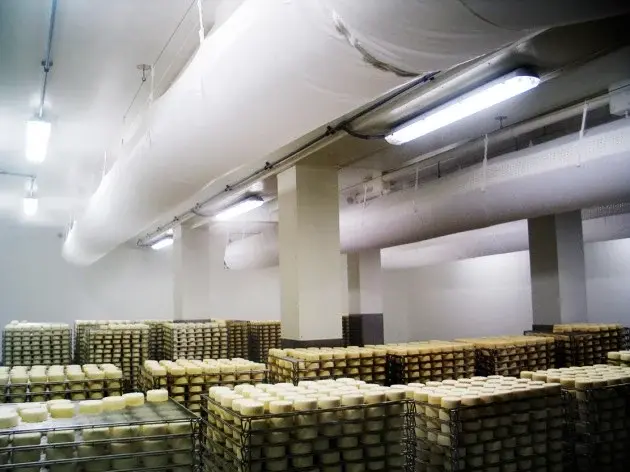
- Porous fabric. Air passes through the weave itself, gently, over the full surface. We specify it for cheese ripening rooms, where an even and non-aggressive airflow protects the rind.
- Longitudinal slots. Oriented laminar jets. The right choice for tall rooms, drip rooms, and any area where flow direction has to be controlled.
On complex layouts we run a CFD simulation and validate performance before anything is fabricated. Start-up surprises get resolved on screen instead of on your floor.
Certified fabrics for every environment
Four families in stock, matched to your room.
- NC polyester. The cheese-making standard, white RAL 9010, holds up to industrial washing.
- Antibacterial polyester. Limits microbial growth between cleaning cycles.
- Antistatic polyester. For ATEX zones, controls electrostatic accumulation.
- Fibreglass or polyurethane. Non-flammable, for fire-risk environments.
Eight standard RAL colours are stocked. Custom colours and printed logos are available to order.
Five fabric duct geometries for real buildings
New construction or retrofit, the profile follows the room.
- Round duct. The versatile default, suits most applications.
- Half-round duct. Ceiling diffusion under low suspended ceilings.
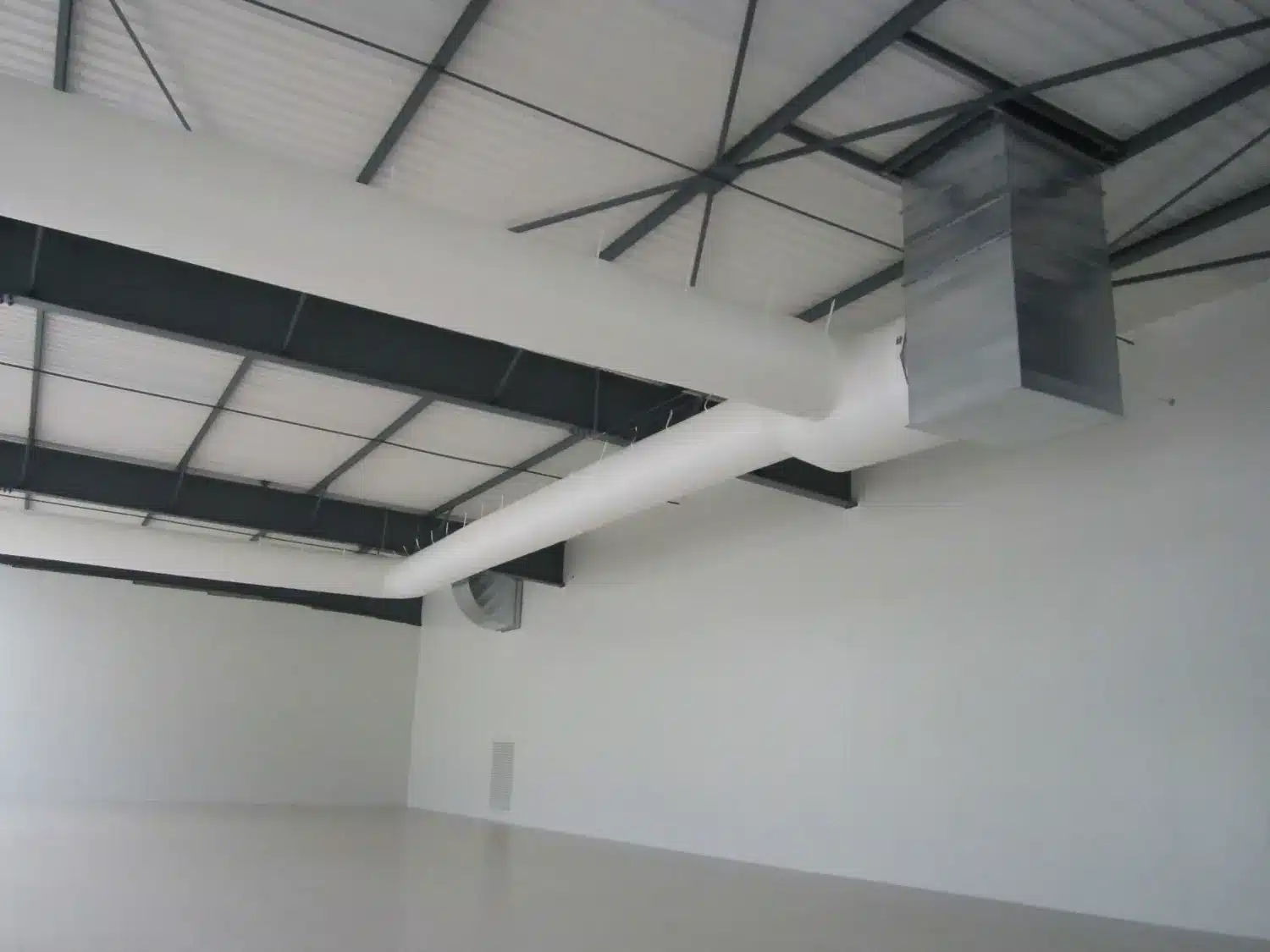
- Elliptical duct. A low profile where headroom is limited.
- Plenum wall. Lateral diffusion in corridors and long rooms.
- Quarter-round duct. Corners and tight service spaces.
The layout stays clean and the airflow performance holds. No structural work is needed to make it fit.
What you gain, before commissioning
Our customers bring us in before the project and keep us for the life of the installation. This is why.
| What we eliminate | What you get | Why it matters to your decision |
|---|---|---|
|
Stagnation zones and hot spots |
A CFD simulation validated before you order |
You go to tender with numbers, not assumptions |
|
Maintenance costs that accumulate over the life of the equipment |
A 10 to 15 year service life, with maintenance your own team can do |
Total cost of ownership lands well under rigid ductwork |
|
Architectural constraints that narrow your options |
The versatility to design your project with five geometries to suit your new or existing production room |
Your building plan stays as drawn, with no added structural work |
|
ATEX or HACCP non-compliance risk |
Certified antistatic, antibacterial and fire-rated fabrics |
Your compliance file is complete the day the fabric is selected |
|
Cross-contamination between production zones |
Evenly distributed air with no aggressive mixing |
Internal audits get easier to prepare |
|
Cleaning that ties up specialized tools and scaffolding |
Machine washing completed in under an hour |
Planned downtime drops measurably |
|
Overconsumption of your refrigeration equipment |
A lower energy bill from the first season |
Payback shows up in the first year |
Certification. ATC ducts meet B-S 1-DO and CAN/ULC S102.2 for the North American market.
Want the numbers for your own room?
Our Flash Audit takes one day on your site. It measures your actual airflows, temperatures and consumption. You get the projected savings and the available incentives in writing. Book a Flash Audit before you specify anything.
A project completed at a client’s site
We maintain your fabric ductwork
Support that continues well past commissioning
A high-performance textile network needs structured monitoring. We inspect each section visually at set intervals. That catches deformation and biofilm deposits before your performance slips. Cleaning runs by machine, on a cycle matched to each fabric family.
Repairs happen on site whenever possible. We patch and restore the duct instead of replacing the whole run. We also verify flow rates and velocities after every major service. A regular maintenance program holds your operating costs down and extends equipment life.
ATC builds it, Soteck Clauger engineers and installs it
Certified technology, applied by a team that works in Quebec plants
ATC is a French manufacturer with an established position in industrial markets worldwide. Its ducts carry CAN/ULC S102.2 approval for the North American market. Our teams have been installing them in demanding food environments across Eastern Canada. That record now runs past 20 years.
Supplying the product is the smallest part of the job. We analyze your airflow and thermal requirements, then size the system. We run CFD simulation where the installation warrants it. Our crews install, commission and train your staff, with one point of contact throughout.
Frequently asked questions about fabric ducts
How long do industrial textile ducts last?
With regular maintenance, an ATC duct lasts 10 to 15 years in normal industrial conditions. Customers who hold a semi-annual cleaning protocol reach the longest service lives. Stainless steel and food-grade plastic accessories add to that longevity.
Can textile ducts be installed in an existing cold room?
Yes, we do this type of retrofit regularly. We first assess your current geometry and flow rates. Then we select the format and fabric that suit your setpoint. Installation causes very little interruption to your production.
Are textile ducts suitable for ATEX zones?
Yes. We specify antistatic polyester approved for hazardous areas. The fabric dissipates accumulated electrostatic charges. It meets the ATEX requirements in force in Canada and Europe.
How are textile ducts cleaned in a food plant?
Removal takes a few minutes and needs no specialized tools. The duct then goes into a washing machine, on a cycle matched to the fabric. We recommend cleaning every three to six months, depending on production intensity. Your own team can run the whole operation.
How does a fabric duct compare to rigid duct for hygiene?
The difference is significant. Rigid ductwork accumulates biofilm in inaccessible areas and requires heavy cleaning work. A fabric duct comes down completely and goes in the washing machine. We visually inspect every section at each maintenance visit, which is impossible with rigid ductwork.
How much energy can a fabric duct save?
Savings come from even distribution, which stops your refrigeration from correcting an uneven load. The gain depends on your room, your setpoints and your current network. A Flash Audit measures it on your site in one day. Whatever we commit to then comes with a written performance guarantee.
What is the lead time on a fabric duct project?
Standard fabrics and the eight stocked RAL colours ship fastest. Custom colours, printed logos and specialty fabrics add production time. CFD simulation, when the layout calls for it, runs in parallel with fabrication. Send us your drawings and we will confirm a schedule against your shutdown window.
Choosing a fabric duct supplierin Eastern Canada
Choosing the manufacturer matters less than choosing who sizes the system. We have delivered fabric ductwork in cheese ripening rooms, dairies, bakeries and cutting rooms. We also work in cold storage and industrial shops.
Send us your plans. Our engineers review the room, the process and the cleaning constraints. We then scope a fabric air distribution system against your numbers. We also take over maintenance and upgrades on existing installations, including systems we did not supply.
What should you check before you order a textile duct system?
Most problems we are called in to fix are sizing problems. The fabric itself almost never fails first. A run that looks right on paper can throw air at the product. Another leaves a dead corner past the last drop.
So start with the room, not the catalogue. Measure the real air volumes, the ceiling height and the washdown cycles. Send us the drawings and your process data. Our engineers size textile ducts against those numbers before anything is cut.
On complex layouts we run a CFD simulation first. You see the throw, the velocities and the mixing on screen. Start-up surprises get settled there instead of on your floor. You also go to tender with numbers rather than assumptions.
What ownership actually costs
A textile air duct comes down in minutes without scaffolding. It goes through a washing machine on a fabric-specific cycle. Your own team can run that cleaning every three to six months. Specialized tools and planned downtime drop out of the budget.
Service life runs 10 to 15 years with regular inspection. We check each section for deformation and biofilm before performance slips. Repairs happen on site, without replacing the whole run. Our maintenance program also covers textile ventilation ducts we did not supply.
Compliance sits in the same file. ATC fabrics meet B-S 1-DO and CAN/ULC S102.2 for North America. Antistatic polyester covers ATEX zones and antibacterial polyester limits growth between washes. Fibreglass and polyurethane options handle fire-risk rooms.
Five geometries exist because rooms are never ideal. Round, half-round, elliptical, plenum wall and quarter-round each solve a clearance problem. A retrofit into an existing cold room rarely needs structural work. Your building plan stays as drawn.
Even air distribution also lowers the load on your refrigeration. That shows up on the first season’s bill. Send us your plans and we will scope fabric duct systems against your constraints. We review existing textile ductwork the same way, no obligation.