
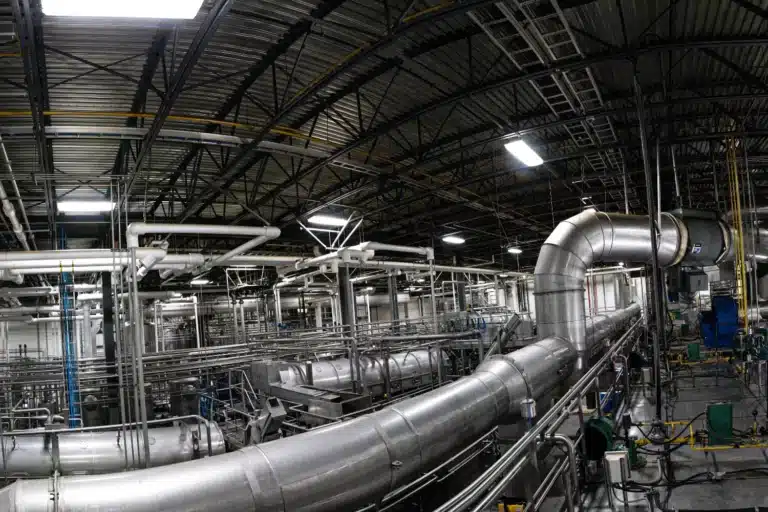
An industrial air treatment system captures, filters, and removes dust, fumes, gases, VOCs, odours, and contaminants from a plant. Its design depends on the contaminants, the required airflow rates, applicable standards, and energy efficiency goals.
Industrial air treatment silently costs money. Flour dust, cooking fumes, VOC particles in the environment, and excessive temperatures and humidity harm workers’ health and drive up absenteeism. They expose the company to inspections by the CNESST, MAPAQ, or CFIA. Yet most managers only invest when the problem becomes impossible to ignore. By then, it’s too late, and significantly more expensive.
At Soteck Clauger, we have assessed dozens of industrial food processing and manufacturing plants. These projects span Quebec and other Canadian provinces. We consistently observe the same pattern in the field. Managers understand that something is wrong. But they don’t know which technology to choose or how to size the system. Nor do they know how to operate it. This guide answers these three questions, straight to the point.
The True Cost of Inaction: Operational Losses and Regulatory Risks
Absenteeism, irritability, and chronic headaches are difficult to quantify, but they are very real. An inspection by the CNESST can result in a fine. The cost can then quickly exceed the savings from not making the investment. Sound reasoning isn’t limited to the system’s purchase price. It’s about the total cost of ownership over time. This calculation includes energy, maintenance, regulatory risks, and team productivity.
Assess your plant’s actual needs before choosing a system
Specifications drafted without on-site measurements almost always result in a system that is incorrectly sized. This leads to two possible scenarios: Either the system is oversized, resulting in unnecessary capital and energy costs, or it is undersized, bringing us back to square one.
Identify and classify the contaminants present on the site
There are four main categories of contaminants. First, solid particles, such as dust, flour, and powders. Next, liquid aerosols, such as oil mist and water vapor; then gases and VOCs; and finally, odours. Within a single plant, several of these categories often coexist in different areas. This requires distinct solutions rather than a single, ill-suited system. On-site measurements always take precedence over assumptions. In Quebec, the IRSST publishes a guide to sampling air contaminants. This document serves as the reference method for this type of assessment.
Sizing the Air Flow Rate
The volumetric flow rate is calculated based on three key factors. The number of occupants and the volume of the space are taken into account. The air change rate required by the applicable standard is then added. This flow rate determines the system’s minimum capacity. To determine the correct flow rates, pressure drop must then be carefully considered. It occurs throughout the ducts, filters, and grilles. It directly determines the power required by the fans. It therefore has a significant impact on long-term energy costs.
Industrial Air Treatment:Filtration and Dust Collection Technologies
The most common mistake in industrial ventilation is not inaction. It is installing a system that does not address the root cause of the problem. Each technology targets a very specific type of contaminant. Confusing these categories will result in systems that run and consume energy but fail to solve anything. Our technical recommendations are based on our expertise in industrial ventilation and air treatment. They are also grounded in proven solutions tailored to each specific case.
High-performance hygienic air treatment and very high levels of filtration
Some food processing operations require much more than standard filtration. They require controlled air quality that meets standards close to those of cleanrooms. This is known as high-performance hygienic air treatment. This level is designed for the most sensitive areas, where the air comes into direct contact with the product. Examples include aging, slicing, aseptic packaging, and the packaging process.
At this stage, filtration reaches HEPA or ULPA levels. It is accompanied by strict control of temperature, humidity, and pressure. The ISO 14644 standard then governs the particulate cleanliness of the air. We apply this expertise in partnership with Valtria, the Clauger Group’s cleanroom specialist. Its cleanroom air treatment units are designed to meet the most demanding environmental requirements. This approach combines Soteck Clauger’s industrial know-how with cleanroom standards.
Air distribution is just as important as air filtration. Poorly designed air distribution can recontaminate even well-filtered air. Our antimicrobial fabric ducts ensure uniform and hygienic air distribution. They are based on Aéro Textile Concept’s (ATC) Airnéo technology, designed for the food industry. Easy to remove and wash, they simplify maintenance in cleanrooms.
HEPA filters, baghouse filters, and cyclone separators
The HEPA filter captures 99.97% of particles measuring 0.3 micrometers. It is the industry standard for ultra-clean production areas. It is used in pharmaceutical cleanrooms and in environments where microbial contamination poses a threat to the product. In the food industry, examples include cheese plants or controlled dust-level rooms. SQF requirements for air cleanliness may therefore mandate a high level of filtration.
This level may extend to HEPA filtration, depending on the requirements and applicable standards. The nature of the identified risks also influences this choice. We provide further details below on high-performance hygienic air treatment designed for these sensitive areas.
Baghouse filters are essential whenever dust volumes become significant. This includes flour, milk powders, and spices. They can achieve up to 90% efficiency for particles as small as 1 micrometer and are built to withstand high-volume operations. However, they require periodic inspections and regular maintenance of the bags. Depending on the dust load, maintenance intervals range from a few weeks to a few months.
Cyclone separators, on the other hand, serve as pre-filters. They separate heavy particles using centrifugal force, without any moving parts. The air then reaches the fine filters, having already been stripped of a significant portion of the dust. In practice, cyclones and baghouse filters are combined in a complete industrial dust collector.
For very fine powders, pleated cartridge filters are a good option; they offer a filtration area two to five times greater than that of conventional filter bags. Their pressure drop is about 20% lower. Their maintenance costs are also reduced by about 60%. However, be aware that replacing them can become a recurring and costly process over the long term.
To make the right choice, compare the volumes, particle fineness, and expected maintenance frequency.
Treatment Systems forVOCs and Atmospheric Emissions
Treatment of Air Emissions
When the contaminant is no longer solid but gaseous, the technology category changes. Air scrubbers simultaneously capture both gases and particles. This system achieves up to 98% efficiency in treating certain compounds, such as ammonia and hydrogen sulfide. On the other hand, they generate liquid waste that must be treated. This adds another management task that must be planned for.
For VOCs and other emissions, the technology used depends on the concentration and nature of the compound. Activated carbon is suitable for low concentrations and batch operations; the latter is primarily used to target odours and other volatile organic compounds. For a comprehensive overview of the available solutions, please review our expertise in ventilation and air treatment.
Capture of Harmful Particles and Gases
Local exhaust ventilation remains more effective and more energy-efficient than general ventilation. A fume hood or extraction arm is positioned as close as possible to the source of emissions. This approach significantly reduces the volume of air that needs to be treated. Dilution through general ventilation, on the other hand, requires a much larger air volume. The IRSST recognizes local exhaust ventilation as a priority strategy. It helps ensure compliance with occupational exposure limit values (OELs). It also prevents the entire system from being oversized.
Welding Fume Extraction
In manufacturing shops, the approach to welding fume extraction is being rethought. If source extraction is not used properly or is not feasible, it will not directly protect the operator. Therefore, our solution is to supply fresh air to the work area and capture the fumes at the top, where they naturally accumulate. This system ensures compliance with CNESST standards for air quality in the worker’s area. It reduces energy consumption for heating air by supplying only the airflow necessary to active workstations. In a shop with multiple workstations, annual savings, adjusted according to operations, can range from 50% to 65% compared to continuous operation.
Industrial Air Treatment:Canadian Standards and Regulatory Requirements
The regulatory framework varies by province, but the fundamental principles remain universal. Compliance is not a ceiling to aim for. Rather, it is a floor that no one should fall below.
Provincial Regulations and CNESST Requirements in Quebec
In Quebec, the Occupational Health and Safety Regulation S-2.1, R. 13 2025 regulates air quality. It addresses air quality and occupational exposure limits (OELs) and sets binding thresholds. They must develop a prevention program tailored to their plant.
Air Exchange Rates and HACCP Requirements in the Food Industry
Minimum air exchange rates vary depending on the use of the premises. In Quebec, Annex III of the Occupational Health and Safety Regulation sets these rates based on the establishment’s classification. The most sensitive areas require more frequent air changes than standard spaces. For agri-food processing plants, HACCP standards impose additional requirements that go beyond workplace safety alone. Incoming air must be filtered before entering production areas. Airflow patterns must prevent any transfer from a contaminated area to a clean area. The systems must also prevent condensation, a direct source of microbial contamination.
SQF requirements govern cleanliness and air quality. They also aim to prevent contamination in sensitive areas. These criteria directly influence the type of system to be installed. They also guide the design of airflow in production areas. For these clean areas, dedicated solutions meet these requirements. Our Thygre, ModulAir, and Access hygienic air treatment units are designed for these environments. Our antimicrobial fabric air ducts ensure controlled air distribution. These choices must be incorporated from the design phase onward.
Actual costs and investment budgetfor your air-handling system
At the start of a project, concrete figures are hard to come by. Here are some realistic estimates in Canadian dollars. They’re meant to help you avoid vague answers and kick off a serious conversation with your vendor.
Initial Investment with Financial Assistance
Flow rate, technology, filtration level, commissioning, and annual maintenance must be considered from the outset.
Financial assistance programs can offset a portion of these costs. Hydro-Québec’s “Solutions efficaces” program supports high-performance ventilation and refrigeration equipment. The Quebec government’s “ÉcoPerformance” program, meanwhile, aims to reduceCO2 emissions. In particular, it provides funding for the retrofitting of mechanical ventilation systems. Incentives cover a significant portion of eligible costs. This portion often ranges from 50% to 75%, depending on the company and the project cost, thereby significantly reducing the net cost of the project. These conditions change regularly and must be verified before any decision is made.
Optimizing fans is often the quickest way to achieve energy savings. Variable-speed operation and intelligent control yield immediate savings. The investment is low, and installation is straightforward. It is frequently the first measure to consider in an energy-efficiency plan.
Heat Recovery and System Optimization: The Dual Drivers of Profitability
Modern air-handling systems are no longer just passive filters. They no longer simply consume energy. When properly integrated, they become true energy assets.
Measurable thermal energy gains
Waste heat recovery offers significant potential. It can result in substantial savings on space heating and/or hot water. In a food processing plant, industrial refrigeration compressors run continuously. This makes the dual benefit particularly relevant, since it allows for the reuse of waste heat. Our Hipack 85 industrial heat pump harnesses this waste heat. It produces hot water from energy that is already available, to meet a wide range of needs in the plant at temperatures up to85°C.
Assess Your Improvement Plans with Soteck Clauger
Soteck Clauger is a systems integrator specializing in hygienic air treatment and energy efficiency. We serve the food processing and manufacturing sectors in Quebec and across Canada. Our approach combines three areas of expertise into a single, cohesive solution. It brings together industrial refrigeration engineering, energy management, and air treatment. Most suppliers, on the other hand, address only part of the problem.
The Flash Audit: A Comprehensive Assessment at No Cost
Soteck Clauger’s Flash Audit is a one-day diagnostic service. It takes place directly at your site. Our engineers identify sources of energy loss and potential savings. The deliverable is an action-oriented report that outlines priorities, recommended technologies, and an estimated return on investment. There is no contractual obligation.
Our Flash Audit is the next logical step. One day on-site, concrete recommendations, and an action plan. Request your free audit today. You’ll get the information you need to make a decision. To learn more about our comprehensive energy efficiency and air treatment solutions, contact our team.
Measuring the performance of installed systems.
Basing decisions on actual measurements fundamentally improves the quality of those decisions. This approach is based on ourAirflow Management Audit (GFA) methodology and/or the Energy Management study.
Our business model covers all your needs. It ranges from measurement to ensuring a project’s contractual performance. It includes engineering, measurement integration, and commissioning. The MyPortal3E platform then takes over. It enables real-time monitoring of the conditions of rooms or systems and energy consumption. The data remains centralized and accessible from your office or your phone.
Financial assistance is also available for studies and metering through Hydro-Québec and Énergir, and the Quebec government’s ÉcoPerformance program supports studies and metering projects; large consumers on the L rate may also be eligible for the Energy Management System program. These programs are subject to change, so please contact us to verify the current eligibility requirements.
Air treatment costs money.
Now you know where to look and what to do.
You have the tools to assess your actual needs, identify your contaminants, choose the right technology, and build a solid financial case based on total cost of ownership. You also know that concrete financial incentives, from Hydro-Québec, ÉcoPerformance, and Énergir, can reduce the net cost of your project by 50% to 75%. But a guide, no matter how comprehensive, is no substitute for on-site measurements. Specifications drafted without real data almost always result in a system that is improperly sized. This is the root cause of all the problems this guide has taught you to avoid.
The next step is simple, risk-free, and free of charge.
One day at your site. Engineers will take measurements, identify sources of energy loss, and quantify potential savings. An action-oriented report outlining priorities, recommended technologies, and an estimated return on investment. No contractual obligation.
At Soteck Clauger, we’ve supported dozens of installations in Quebec and across Canada using this same approach: measure first, recommend next, and deliver with a performance guarantee. You’ll get the data you need to make decisions and take action at the right time, rather than too late.
Measuring the performance of installed systems.
Basing decisions on actual measurements fundamentally improves the quality of those decisions. This approach is based on ourAirflow Management Audit (GFA) methodology and/or the Energy Management study.
Our business model covers all your needs. It ranges from measurement to ensuring a project’s contractual performance. It includes engineering, measurement integration, and commissioning. The MyPortal3E platform then takes over. It enables real-time monitoring of the conditions of rooms or systems and energy consumption. The data remains centralized and accessible from your office or your phone.
Financial assistance is also available for studies and metering through Hydro-Québec and Énergir, and the Quebec government’s ÉcoPerformance program supports studies and metering projects; large consumers on the L rate may also be eligible for the Energy Management System program. These programs are subject to change, so please contact us to verify the current eligibility requirements.
Article written in collaboration with our expert:

Have you completed your Flash audit and received your improvement plans?
Let’s talk about what comes next. Our experts will explain how our model safeguards your investment, from design through performance guarantees.
Notes: All regulatory information was verified as of July 1, 2026.
A guide outlines the main points.
The situation raises more specific questions.
What kind of filtration system should I use for my cheese plant? Which incentive program applies to my project? How can I justify the investment to my management? These six questions come up time and time again in our assessments. Here are the answers, straight to the point.
Technical FAQ
What managers ask us most often
Q1: How do you size an industrial air-handling system?
The sizing process begins by identifying the contaminants present. There are four categories: solid particles, liquid aerosols, gases/VOCs, and odours. Each category requires a different technology.
The volumetric flow rate is calculated using three values:
- Area volume and number of occupants
- Renewal rate required by the applicable standard
- Concentrations and types of contaminants measured on site
Pressure drop is often underestimated. It occurs throughout the ducts, filters, and grilles. It determines the actual power of the fans. A 20% error in this calculation can double annual electricity consumption.
The IRSST has published a reference guide for air sampling in Quebec. This document outlines the methodology for field assessments.
A properly sized system is less expensive to operate. It avoids the two common pitfalls: oversizing and undersizing.
💡 Soteck Clauger’sGFA Audit measures flow rates, temperatures, and contaminants at your site in a single day. It’s the only reliable starting point.
Q2: What type of filtration should be used in a food processing plant?
The filtration method is selected based on the area, the contaminant, and the level of health risk. There is no one-size-fits-all solution.
Baghouse filters: These are essential for flour, milk powders, and spices. They are 90% effective at capturing particles as small as 1 micrometer. Maintenance intervals range from a few weeks to a few months.
Pleated cartridge filters: Their filter surface area is 2 to 5 times greater than that of baghouse filters. Their pressure drop is 20% lower. Maintenance costs are reduced by approximately 60%.
HEPA filters: They capture 99.97% of particles measuring 0.3 micrometers. They are required for aging, slicing, and sterile packaging. The ISO 14644 standard governs this level of particle cleanliness.
Air distribution is just as critical as filtration. Well-filtered air can become recontaminated due to poor distribution.
💡 Our Thygre, ModulAir, and Access air treatment units, when used in combination with Airnéo (ATC) ducts, meet the most stringent HACCP and SQF requirements.
Q3: What is the difference between general ventilation and local exhaust ventilation?
These two approaches are not interchangeable. Confusing them leads to costly systems that don’t solve anything.
General ventilation dilutes contaminants throughout the entire air volume. It requires very high airflow rates. It is energy-intensive. It does not directly protect the operator at the source of the emissions.
Source capture intercepts pollutants at the point of emission. A hood or an extraction arm is sufficient. The volume of air treated is drastically reduced. The IRSST recognizes this strategy as a priority for complying with occupational exposure limits.
In welding shops, direct extraction isn’t always feasible. Our approach: delivering fresh air at the worker’s eye level. Fumes rise naturally and are captured at the top. This system, which is scaled to the number of active workstations, generates savings of 50% to 65%. It ensures compliance with CNESST standards for workplace air quality.
💡 Fundamental principle: source capture first. While general ventilation is comprehensive, it never replaces workplace protection.
Q4: What standards govern industrial air quality in Quebec?
Regulatory compliance is a minimum requirement, not a goal.
Here are the specific provisions that apply.
- RSST (S-2.1, r. 13, 2025): This CNESST regulation establishes the VEMP and VLEP for each contaminant. Each employer must develop a prevention program tailored to its plant. An inspection may take place at any time.
- Appendix III of the RSST: It specifies the minimum air exchange rates by type of room. Sensitive areas require higher rates.
- HACCP (food industry): Incoming air must be filtered before entering production areas. Airflow must never move from a contaminated area to a clean area. Condensation is a direct source of microbial contamination and must be eliminated.
- SQF and ISO 14644: These standards govern the particulate cleanliness of cleanrooms and aging areas.
In the event of noncompliance, the CNESST, the MAPAQ, or the CFIA may order a production shutdown.
💡 A documented prevention program based on on-site measures is mandatory. It is also the first document requested during an inspection.
Q5: What incentives are available to fund an air treatment project?
Several programs effectively reduce the net cost of a project. Incentives often cover 50% to 75% of eligible costs.
- Solutions efficaces, Hydro-Québec: It provides funding for high-efficiency ventilation equipment. It also covers measurement studies and energy-efficient refrigeration projects.
- ÉcoPerformance, Government of Quebec: This program aims to reduce GHG emissions. It provides funding for the retrofitting of mechanical ventilation systems. Preliminary studies are also eligible.
- Energy Management System Program: reserved for large consumers on the L rate plan. It provides funding for a structured energy management approach based on measurable indicators.
- Énergir: Incentives are available for projects involving the recovery of waste heat and thermal efficiency.
These programs are subject to change on a regular basis. The terms and conditions must be verified before any investment decision is made. A preliminary study is often required to submit an application.
💡 Soteck Clauger assists you in preparing incentive applications. We verify the eligibility requirements in effect at the time of your project.
Q6: How can you reduce the energy consumption of a ventilation system?
A ventilation system can become an energy asset. Here are four practical steps you can take.
- Variable-speed drive (VFD): This is the most accessible option. A fan’s power is proportional to the cube of its speed. Reducing the speed by 20% cuts energy consumption by nearly 1.5 times. Installation is simple. The return on investment is quick.
- Active-Zone Modulation: In a multi-station shop, power only the active stations. Savings range from 50% to 65% compared to continuous operation.
- Waste Heat Recovery: In a food processing plant, refrigeration compressors run continuously. This heat is free and readily available. Our Hipack 85 industrial heat pump harnesses it to produce hot water at temperatures up to 85 °C to meet the plant’s needs.
- Monitoring and Management: The MyPortal3E platform centralizes data in real time. It detects deviations before they become costly.
💡 Our Airflow Management (GFA) Audit quantifies your potential savings using measured data before you make any investment.