
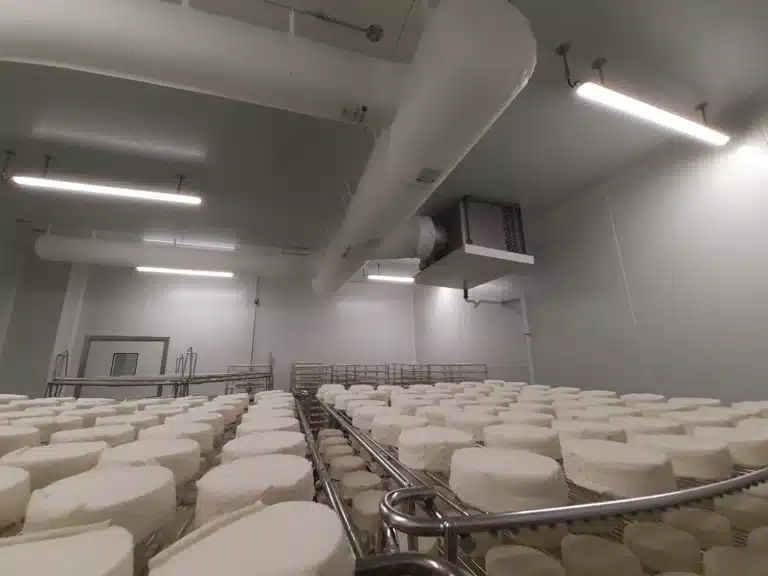
Humidity: a dynamic balance, not a set point
In cheese aging, humidity is often treated as a control variable. A target percentage, generally between 85% and 98%, that we aim to maintain at all times. But this is a simplistic view.
Humidity, in reality, is not a state. It’s a flow. It depends constantly on exchanges between air, cheese, surfaces and ventilation movements.
Each cheese releases water. Each air circulation evacuates some of it. Each temperature variation modifies the air’s capacity to retain this moisture. So we’re dealing with a system in dynamic equilibrium.
This is precisely where mistakes are made.
Apparently homogeneous, in reality heterogeneous humidity
In many aging rooms, the instruments indicate stable values. However, as soon as you look at the cheeses, differences appear.
Some pieces develop a soft, fine, even crust. Others, placed in close proximity, have a drier or slightly sticky surface.
These discrepancies can rarely be explained by the setpoint itself. They are linked to the actual distribution of humidity in the space.
Air, even conditioned air, does not behave uniformly. It follows trajectories, accelerating in some areas, slowing down in others. It bypasses obstacles, accumulates locally, or renews itself more rapidly depending on the configuration of the room.
This results in microclimates. These differences may be small, but they are enough to influence the exchanges between the cheese and its environment.
These exchanges are at the heart of aging.
Free water: a disturbance often underestimated
A common mistake is to equate humidification with water supply.
In some installations, humidity is generated in the form of excessive droplets. These droplets do not remain suspended in the air, and end up settling on the cheese or the shelves.
This phenomenon introduces free water to the surface.
This water profoundly alters local conditions. It creates a saturated zone, prevents normal gas exchange and disrupts the development of micro-organisms.
On a bloomy rind, it can slow down Penicillium candidum colonization. On lactic cheese, it can lead to appearance defects. And in a washed-rind aging room, this local excess can destabilize a fragile microbial balance.
The central role of air-cheese exchanges
The aging process is based on constant exchanges between the cheese and the ambient air.
These exchanges involve both water and gases. When humidity is poorly controlled, these flows become irregular.
Air that’s too dry accelerates water loss. Air that’s too humid slows it down. But air speed also plays a decisive role.
Rapid air flow accentuates exchanges. Stagnant air slows them down.
This is why two cheeses in the same aging room can develop differently depending on their position.
Air circulation: the key to coherence
Humidity management cannot be dissociated from air management.
A well-humidified but poorly ventilated room will always produce unstable results. Some areas will become accumulation points, others over-drying zones.
These imbalances are often at the root of production defects.
A fine reading by cheese type
Not all cheeses express defects in the same way.
A soft cheese reacts quickly. A pressed cheese shows the variation over time. A washed rind requires very fine stability.
The cheese then becomes an indicator of the aging room itself.
In conclusion: reading imbalances
A humid aging room can’t be controlled by instruments alone. It has to be understood.
Visible defects are often the consequences of an invisible imbalance.
With experience, you learn to anticipate them. And that’s where aging comes into its own.
What type of cheese plant are you or do you want to become?
Every aging room is unique. Whether you’re starting up a small-batch cheese plant, looking to correct a specific problem, or optimizing an existing plant, our team can help.
Whatever your level of maturity, the fundamental issues remain the same: understanding your environment, stabilizing your conditions, and developing your mastery. The difference is the level of precision you choose to achieve.
We’re there for you every step of the way, from initial analysis to production support. Our team of specialists works with cheese plants across Canada and the United States.
| Profile | Your reality | Your challenges | Key solutions | What it does for you |
|---|---|---|---|---|
|
Start-up cheesemaker / small-batch plant |
You launch or structure your production. Every batch counts. |
– Stabilize your first aging batches – Avoid losses – Understand your environment |
– GFA audit (in case of doubt or problem) – Circul’Air or Access solution – Hum-Kit (humidity-based) |
A reliable basis for regular production, without unnecessary complexity.
|
|
Growing cheese plant |
Your production is increasing. You’re looking for more consistency.
|
– Reduce batch-to-batch variation |
– ModulAir (Climinox) |
Fewer corrections, more consistency, better overall control. |
|
Advanced / Expert cheesemaking |
You’re looking for precision, reproducibility and fine-tuning. |
– Control your conditions with precision |
– Thygre range |
Controlled, measured, reproducible aging. |
Article written by

Important note
The results presented are based on a real project, documented under specific operating conditions. As each installation is unique, performance may vary according to the volume treated, the nature of the process, thermal loads and ambient conditions. That’s why we always recommend a concept analysis tailored to your reality before making any investment decision.