
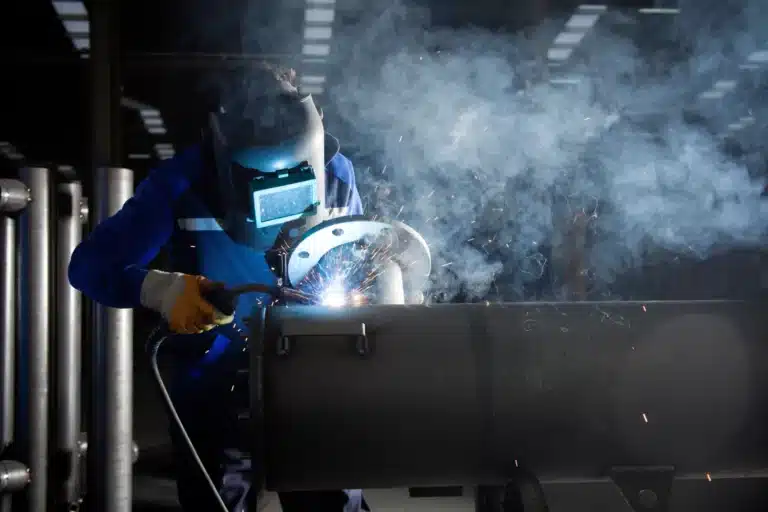
There’s a problem that almost no one names correctly in the welding shops of Centre-du-Québec. We’re talking about retention. We’re talking recruitment. They talk about energy costs. But rarely all three together. And even more rarely about their common cause.
But it does exist. And it circulates in your ventilation ducts.
When welding shop air becomes a human resources issue
Sylvain Mercure wasn’t looking to improve the air quality in his welding shop. He was trying to understand why his best welders were leaving.
At Métallo-Tech Drummond in Drummondville, the order book had never been so full. Yet three experienced welders had resigned in the space of twelve months. The reasons given were vague. Difficult working conditions. Fatigue. End-of-shift headaches.
His CFO was looking at a different curve. Energy costs had been jumping 15% per quarter for the past six months. With no increase in production. With no clear explanation.
These are two separate problems. Or so Sylvain thought.
The reality in welding shops is that reducing welder absenteeism in metal fabrication starts with the air they breathe.
The Quebec standard sets the maximum concentration of welding fumes at 5 mg/m³, according to the Regulation respecting the quality of the work environment S-2.1, r.21. But between meeting the standard on paper and maintaining an environment where welders want to work day after day, there’s a considerable margin.
In workshops where welders are mobile, always moving from one station to another, conventional systems struggle to keep up. Fixed hoods don’t reach the source. Articulated arms get in the way and end up standing still in the corner. Ventilation runs at full speed all the time, whether there’s activity or not. And contaminated air stagnates where people are working.
The warning signalthe CFO unknowingly sent out
When Métallo-Tech Drummond’s CFO presented the figures for the last quarter, Sylvain had an unusual reflex. Instead of looking for jobs to cut, he asked for a correlation.
He superimposed the energy cost curve on the absenteeism curve. The two were rising together. Not perfectly, but enough to beg the question: what if the same system was fuelling both problems?
That’s when he contacted the Soteck Clauger team, which specializes in industrial air treatment and 4.0 energy efficiency for manufacturing plants in Quebec. He didn’t expect the analysis to confirm his intuition so quickly.
What the free ventilation audit revealed in just a few hours
The field diagnosis carried out at Métallo-Tech Drummond revealed three realities that no-one had previously documented together.
The ventilation system operated in binary mode: all or nothing, from the start to the end of the shift. It consumed as much energy during breaks as during periods of intense welding. The building was not maintained at neutral pressure. Every time a garage door was opened, outside air – cold in winter and humid in summer – rushed in, forcing the heating system to compensate. Power demand peaks regularly exceeded the threshold agreed with Hydro-Québec, generating automatic penalties.
Above all, in the areas where welders spent most of their time, fume and gas concentrations were not measured in real time. Compliance with the cost of welding fumes according to regulation S-2.1 r.21 was assumed. This was not verified.
SOUD-AIR : an intelligent variable-flow ventilation system for welding applications
Le concept déployé par Soteck Clauger dans l’atelier de de Martin repose sur une logique simple : l’air traité doit suivre l’activité réelle, pas un horaire fixe.
SOUD-AIR detects in real time the activity of each welder: plasma, MIG, TIG. When a station is in operation, the zone damper opens fully and the airflow increases automatically. When workers are on the move or on break, the system reduces consumption to 50% or less. A variable-flow make-up air system maintains the workshop between 16°C and 19°C supply air, with a stable room temperature of 20°C, without overheating or infiltration.
An integrated power manager continuously monitors electricity consumption. It intelligently unloads heating elements to avoid exceeding the power contracted with Hydro-Québec. Penalties disappear. Bills stabilize. Energy savings in welding workshops in the Centre-du-Québec region are what make this type of investment concrete and quantifiable.
On the human side, results were documented over 14 months. Absenteeism on the shop floor fell by 24% in the first year. No voluntary departures among welders in post since deployment. Welding fume exposure values, measured by an accredited third party, have remained below regulatory thresholds at every workstation.
On the energy side: reduction in power demand of 80 to 100 kW per month in winter, representing annual savings of between $7,400 and $9,260 on this item alone. Heating savings: approximately $32,000 per year. The return on investment for an industrial ventilation system was achieved in less than 22 months.
A competitive lever thatyour competitors haven't yet activated
In the metal fabrication shops of Centre-du-Québec, the war for welding talent is real. Recruiting a qualified welder costs between $8,000 and $15,000 in time, training and lost productivity.
Keeping one starts with the air he breathes eight hours a day.
Sylvain Mercure realized this after the fact. He would have preferred to understand it before losing three of his best.
Your welding shop may be getting the same signals. Costs rising for no obvious reason. Absences piling up. Workers not complaining, but leaving.
A free ventilation audit for your welding plant in Centre-du-Québec, or the surrounding area, takes half a day. The analysis is non-binding. What it reveals often changes the way you read your figures.
Request your free ventilation audit
Article written by

Important note
Sylvain Mercure is a fictional character based on real-life situations encountered by the Soteck Clauger team in the welding shops of Centre-du-Québec. His first name, on the other hand, is so common in the Drummondville factories that we could almost put it on the form in advance. Actual performance will vary according to each plant: volume treated, process, thermal loads and ambient conditions. We recommend a concept study before making any investment decision.