
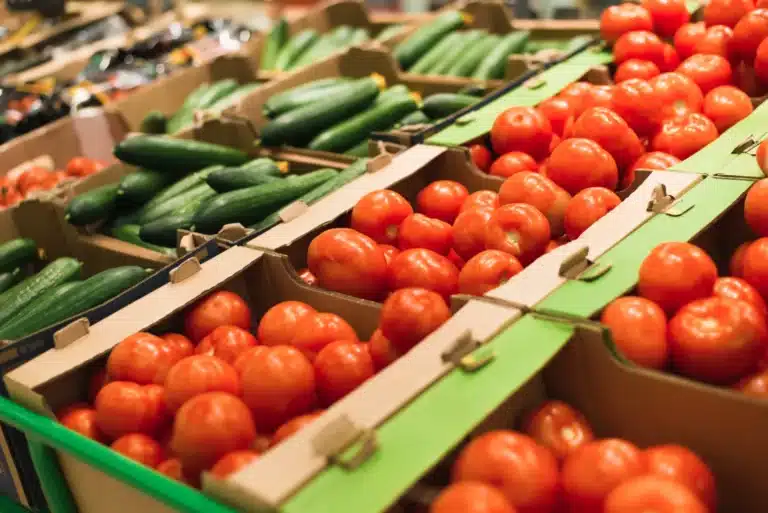
Cold Storage: A Real-World Scenario.
It’s 6 a.m. Caroline Bélanger pushes open the door to her cold storage room. The air smells like overripe vegetables. On her desk, a number troubles her: 6% of the last batch was rejected. Outside, the thermometer already reads 32 °C. The July heat wave is just beginning.
Summer: The True Test of Cold Weather
In Quebec, summer puts cold storage to the test. Crops arrive in droves. Cold storage units are running at full capacity. And every degree counts. For agri-food producers, preservation depends on three key factors: temperature, humidity, and air circulation.
At what temperature should fruits and vegetables be stored? The answer varies depending on the product. But even a slight deviation can result in losses. Here are the recommended targets for effective cold storage.
| Parameter | Recommended target | Consequences of an Uncontrolled Deviation |
|---|---|---|
|
Temperature |
0 to 4 °C |
Accelerated ripening, loss of firmness |
|
Relative humidity |
90 to 95 percent |
Dehydration, wilting |
|
Air Exchange |
20 to 40 volumes per hour |
Hot spots, condensation, mold |
|
CO₂ Level |
less than 1% |
Browning, change in taste |
It’s simple: it’s not the major breakdowns that cost a lot. It’s the small, repeated deviations, day after day, across hundreds of pallets.
The Day Everything Changes
The breaking point comes on a Friday. A distributor rejects an entire pallet of bell peppers. The reason: they aren’t firm enough. That same day, Caroline opens her Hydro bill. It’s up 18% in just one month. She then realizes that her two problems are actually one and the same. Why is my electricity bill going up in the summer, just as my produce losses are increasing? The question keeps running through her mind.
Measure Before You Change It
That’s when we step in. We didn’t show up with a catalog. We showed up with questions. How does air circulate in your rooms? Where are your hot spots? When do your systems work the hardest?
At Soteck Clauger, we believe thata thorough assessment is better than expensive equipment. Our approach is based on a simple idea: clean air and efficient refrigeration aren’t mutually exclusive, they reinforce each other. So we offered Caroline an energy audit for her cold storage plant. The first step: take measurements, before touching anything.
What the auditrevealed
The audit brought what was invisible to light. The fans were spinning fast, but the air wasn’t reaching every area.
As a result, areas with temperatures of 7 °C were adjacent to areas with temperatures of 2 °C. Humidity, meanwhile, dropped below 85% in the afternoon.
That’s why maintaining stable humidity levels during storage is a key factor in profitability. We also measured the actual load on the compressors. They were running nonstop due to a lack of fine-tuned control.
How can you reduce losses in a cold storage room? By first stabilizing these cold storage conditions. Every point of humidity lost means a loss of quality, and profit.
A Transformation in Numbers
We took action on three fronts. First, we redesigned the air distribution system with stainless-steel air conditioners, designed for hygiene and easy to clean. Next, we installed a smart control system connected to a real-time warehouse monitoring system.
Finally, we optimized cooling capacity with a low-NH3-load refrigeration solution, supplemented by CO2. These are two natural fluids with a low carbon footprint. The results were quickly evident. The rejection rate dropped from about 6% to less than 2%. The energy bill fell by about 22%. Humidity stabilized at ±2%.
The return on investment was realized in just under three years. As an added bonus, the heat recovered from the compressors is now used to preheat the wash water, a benefit that no one had anticipated.
A Summer We Make Our Own
A year later, Caroline is no longer at the mercy of the summer. She’s in control. Her inventory data informs her decisions, season after season. She knows which products to stock, for how long, and at what cost.
And this trend is not going to reverse. In eastern Canada, heat waves are expected to become longer and more frequent over the coming decades. This is the conclusion reached by the Ouranos consortium and the *Changing Climate in Canada* report.
That is why the choice of refrigerants is just as important as the equipment itself. NH3 and CO2 have a low carbon footprint. They are becoming valuable allies in the fight against climate change.
And they are able to withstand increasingly stringent regulations on gases with high global warming potential. Over a three-year period, this performance gap becomes a sustainable competitive advantage. The third generation thus inherits a system that is ready for the hotter, more demanding summers ahead.
How about you, what are your plans for this summer?
What about you? How many kilos are leaving your cold storage this summer without ever being sold? The heat wave isn’t going to let up. But your plants can become smarter.
We offer a customized analysis of your cold storage operations, based on your actual data. Not a sales pitch. A clear assessment, backed by numbers.
At Soteck Clauger, we believe that well-managed cooling protects your products,
your profit margin, and the planet.
Article written in collaboration with:

Important note
Caroline Bélanger is a fictional character. The results mentioned are entirely realistic for this type of project undertaken by the Soteck Clauger team. Actual performance varies depending on each installation: treated volume, process, thermal loads, and ambient conditions. We recommend conducting a feasibility study before making any investment decisions.
Sources
- Ouranos, “Heat Waves: Projected Changes,” (accessed June 11, 2026).
- Ouranos, “Temperatures: Projected Changes,” (accessed June 11, 2026).
- Government of Canada, Canada’s Changing Climate Report, “Regional Outlook: Quebec,” (accessed June 11, 2026).