
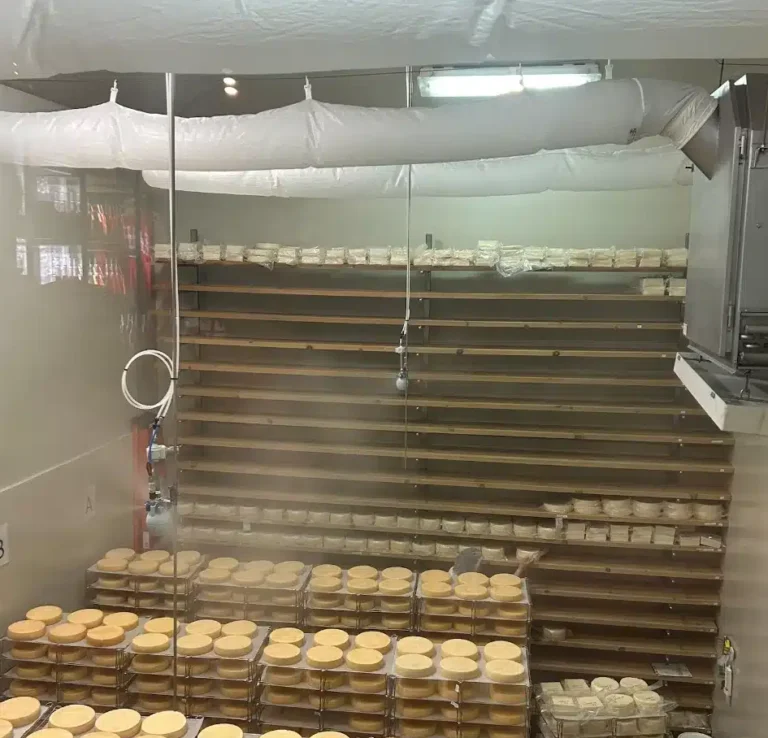
The moment when everything changed
Some decisions don’t start with a big, spectacular problem. Sometimes, it starts with a simple sentence, said almost in jest, in a factory where everyone is already running out of time. The head of a Quebec cheese factory (let’s call him Pierre) summed it up this way:
“Temperature is easy… but humidity, that’s another game.”
And in a maturing room, this “game” can be played to within a few grams.
Because cheese is ultimately sold by weight. And when you’re talking about thousands of wheels a year, imperfect humidity control isn’t just a matter of comfort or technique. It’s a question of profitability. Consistency. And quality.
The reality of refining today: quality, consistency and pressure
In the food industry, refining is often seen as an art. But in operations, it is above all a sensitive area where variations are costly.
Even when a cheese dairy already has a good base – functional refrigeration, temperature control, alarms, monitoring – there’s still one dimension that completely changes the dynamic: humidity control in the ripening room.
Pierre already had alarm and temperature management. He even had some of the automation in place. But humidity remained partially controlled. And like many companies, it had become accustomed to fluctuations:
“We do the best we can.”
Except that the best in refining comes at a price. And it’s measured in the final weight.
The breaking point: when improvement becomes a matter of course
Initially, Pierre didn’t expect a major transformation. This was not a factory in crisis. He wasn’t looking for a “miracle”. He wanted to improve. But as the weeks went by, one thing became clear: humidity control was not a secondary option. It was a direct lever on refining quality, and above all, on consistency of results.
He put it very simply:
“It’s more of a qualitative investment than a spectacular one… but one that pays off quickly.”
And this kind of phrase, in a food company, is worth thinking about.
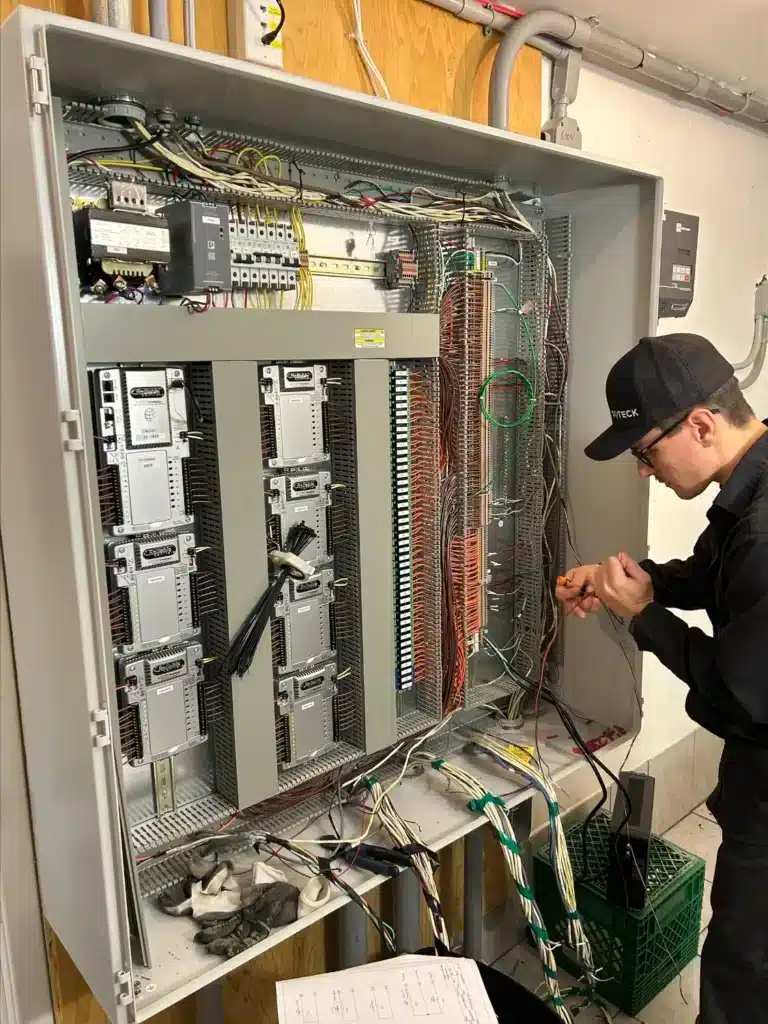
Our team in action
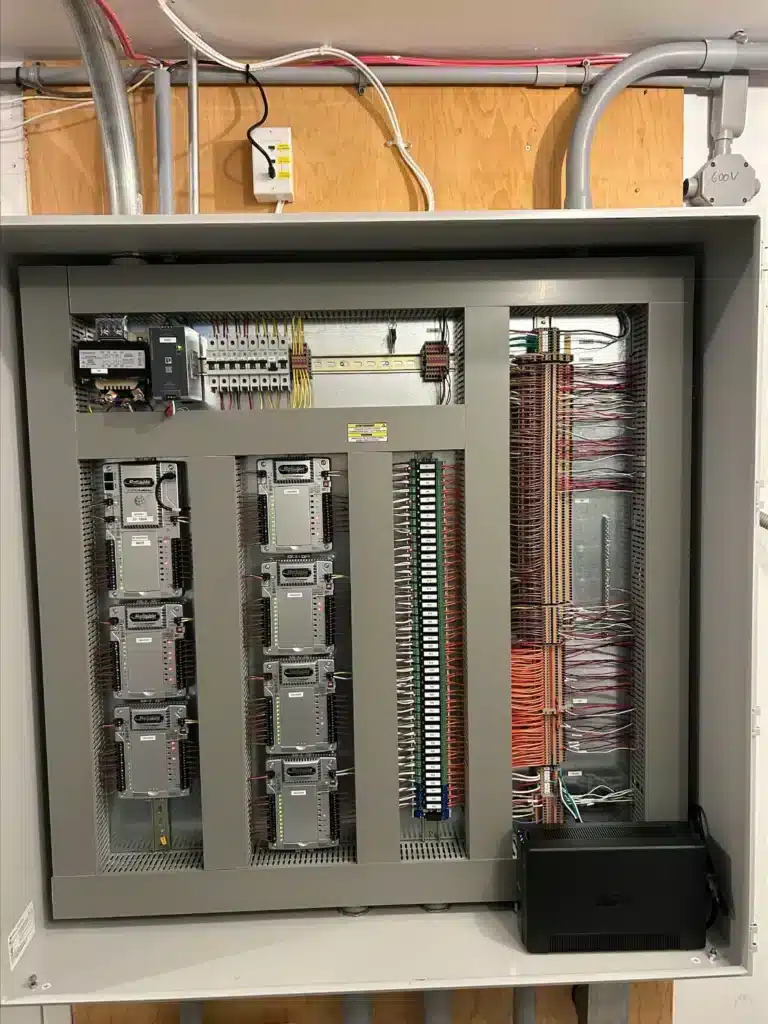
Our end product
Discovery: an approach that combines control and simplicity
That’s where our Soteck Clauger team came in.
Not with a “start from scratch ” approach, but rather with a very grounded logic: understand what already works, then complement it intelligently. In this project, one element made all the difference: the ability to integrate new into existing, without imposing a complete replacement. Pierre made it clear that, to guarantee 100% performance, many suppliers would have preferred to rip everything out and start again “from scratch”. But that wasn’t the philosophy here.
The aim was not to change for the sake of changing. The aim was to achieve a concrete result: stabilize humidity, improve refining, and give the team a clear, intuitive, user-friendly interface.
And above all: achieve a measurable gain.
The revealing analysis: what moisture steals in silence
When we think of losses in the ripening room, we often think of rejects or visible problems. But humidity does things differently. It flies silently.
Pierre summed up the impact in a simple image:
“Whether we go for 100g per wheel, or 200g per wheel. It makes a big difference.”
This was no hypothesis. It was observable for 30,000 millstones a year.
From there, the calculation becomes brutally simple. Even with a conservative assumption of 50g per wheel, we’re talking about an extra 1,500kg of cheese per year. And in his case, the cheese was selling for around $35/kg.
Result: approximately $52,000 inadditional revenue
Not over 5 years. Not “maybe”. Over a single year. Measurable transformation: +$52,000 and more stable quality Once the system was in place, the benefits quickly became apparent.
The first is direct gain: more final weight per wheel. And in an agri-food company, and especially in a cheese dairy, a stable weight gain is one of the most powerful performance indicators… because it doesn’t depend on a change of team, or a daily effort. It comes from the process.
The second is quality. As Pierre said, the difference can be seen in the quality of the maturing process. Even if the gain is difficult to quantify in terms of “score”, the impact on the final product is real. The cheese is more consistent, its behavior in the cellar is more predictable, and production can be better standardized.
The third is the operating experience. A control panel, “panel for panel”, doesn’t change anything… except when the interface becomes pleasant, navigation is intuitive, and alarms are better managed. In his case, this was also an important point: less stress, greater clarity, and a better ability to intervene quickly.
We’re talking here about a real step towards agri-food automation, but in its most useful form: one that serves the operator, rather than complicating him.
The vision for the future: a system that evolves with the plant
This project wasn’t a one-shot deal. As Pierre said, the plant is a work in progress. There will always be adjustments, questions, fine-tuning. But now he has a solid base.
Above all, it’s a system that can evolve. Because once humidity control in the ripening room is mastered, the door is opened to other gains: greater consistency, better planning, fewer surprises, and potentially more future integrations.
In conclusion: If your humidity was costing you around $50,000 a year.
This case is anonymized, but it represents an extremely common reality. Cheese dairies and agri-businesses that are already doing a lot of things right… but are unknowingly leaving thousands of dollars on the table because of imperfect humidity control.
And what if, for you too, the gain was not in a new product, but in 50 g per wheel?
If you like, we can help you assess the potential in your ripening rooms, with no hard sell, just a clear analysis based on your volumes, parameters and objectives.
Because sometimes, in a factory, it’s not a revolution that changes everything. It’s just the humidity.
Analysis by

Important note
The results presented in this case study are specific to the operating conditions of the documented project. They are provided for guidance only. Actual performance depends on the specific parameters of each installation, including volume processed, nature of the process, thermal loads and ambient conditions. Soteck Clauger recommends a thorough concept study before making any investment decision.